
Dear Friends,
Thanks to your support, in August we announced funding for two
more transformative research projects that could deepen our
understanding of why Crohn's disease happens. Both projects,
which are already underway, embrace new approaches and will be
testing novel treatments in the lab. Read more below about
these exciting initiatives from teams at Stanford University
and the Mater Research Institute.
As always, these updates come
directly from the scientists leading the projects you sponsor.
This is work happening in real time, led by scientists who
believe, like you do, that cures for Crohn's disease are
absolutely possible.
Your support enables us
to fund specialists across different areas of research—from
immunology to microbiology and even chemical engineering—who
are tackling important questions about Crohn's disease that
remain underexplored or have never been addressed before.
Every finding and every project brings us one step closer to
cures. We salute these teams who are dedicated to improving
the lives of IBD patients and you for making their work
possible.
Sincerely,

ANGELA CLARK
President and CEO
|
|
SPONSORED PROJECT UPDATES
|
|
|
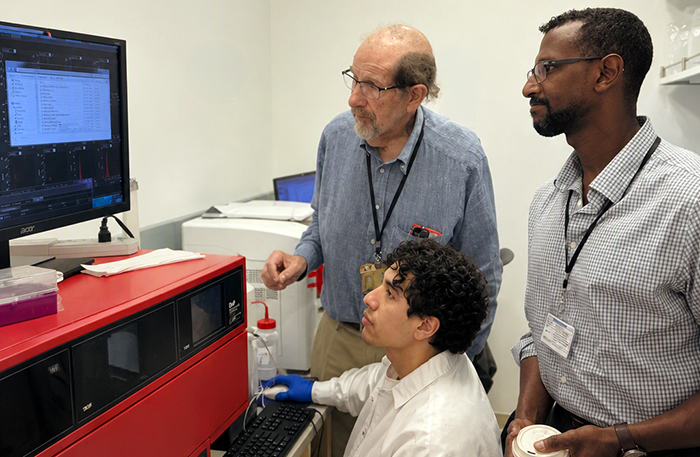
Investigating Mitochondrial Damage in Crohn's Disease
|
With the support of Propel a Cure, in partnership with the
Mendez Family Foundation, the Weinberg and Haileselassie Labs
at Stanford University recently began their project to
investigate how mitochondrial damage in intestinal epithelial
cells may be driving Crohn's disease.
The scientists have started growing cells from patients'
endoscopic biopsies of the colon or ileum into
three-dimensional "organoids." These intestinal
patient-derived organoids are small spherical bodies in which
the epithelial cells grow and develop, forming organized
structures similar to that of the bowel.
The team will compare mitochondria (the "powerhouse of the
cell") in intestinal organoids from patients with Crohn's
disease that is either poorly controlled or in remission with
those in organoids derived from healthy individuals. These
organoids, which serve as a "disease in a dish" model, will
allow investigators to examine the mitochondria under a
microscope and measure potential defects in their ability to
produce energy in intestinal epithelial cells affected by
Crohn's disease.
The team has begun growing the first intestinal organoids from
a patient with Crohn's disease and a healthy control. Once the
researchers establish a baseline for mitochondrial function,
they will test how the organoids respond to stress caused by
exposure to immune cells, extracellular mitochondria (ExMito),
or chemicals produced by microbes.
The overall goal will be to develop and test a
nonimmunosuppresive therapeutic designed to treat Crohn's
disease by preventing mitochondrial damage and the release
of ExMito, thereby improving the health of the intestinal
epithelium.
For the first time, the U.S. Food and Drug Administration has
recently approved new drugs for treating diseases, based on
testing in organoid models.
If the researchers can identify mitochondrial abnormalities
and demonstrate that their drug can correct them, this
approach could potentially accelerate the path from drug
discovery to testing in patients.
|
|
|
|
|
Searching for Gut Bacteria That May Protect Against
Intestinal Fibrosis
|
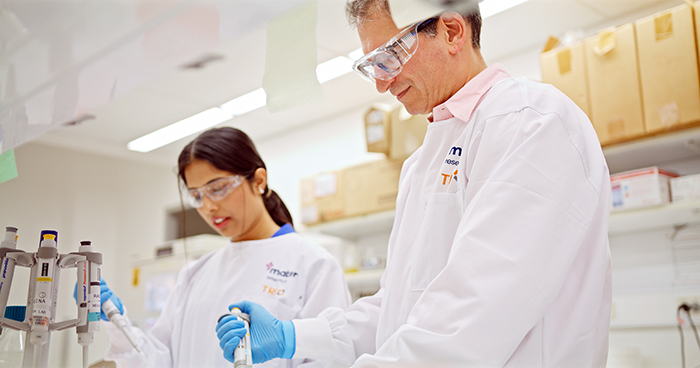
The team leading Propel a Cure's newly funded project at the
Mater Research Institute (University of Queensland) has been
expanding its search for gut bacteria that may protect against
intestinal fibrosis in Crohn's disease. Building on its
initial screening of 96 bacterial isolates, the team has now
screened additional isolates and identified promising
candidates that may be able to modify biological processes
involved in the development of fibrosis.
The researchers are now obtaining additional strains of one of
their most promising bacterial species to determine whether
its protective effects are unique to the strain originally
identified or are shared by other strains of the same species.
At the same time, they are continuing to screen additional
bacterial isolates in search of other candidates with
protective effects. The strongest candidates will then be
prioritized for studies to identify which substances they
produce are responsible for these effects.
This work represents an important early step toward
identifying ways to harness the gut microbiome to help
prevent or reduce intestinal fibrosis in Crohn's disease
patients.
|
|
|
|
|
Uncovering Why Immune Cells Struggle to Clear Bacteria in
Crohn's Disease
|
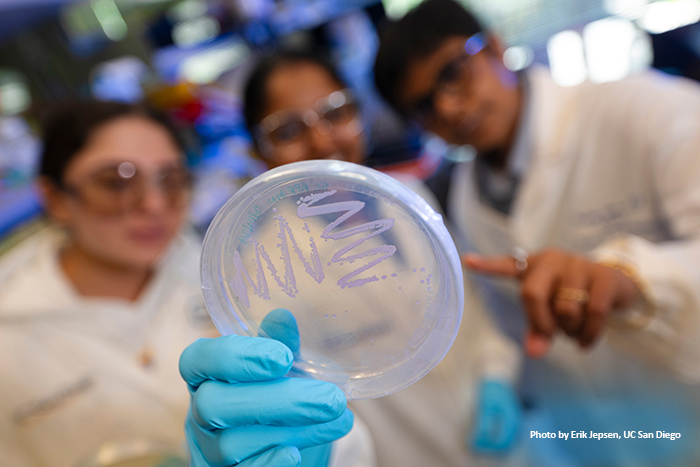
As part of Propel a Cure's funded project at UC San Diego, the
Ghosh Lab is investigating how immune cells recognize and
destroy harmful bacteria and what goes wrong in this process
in Crohn's disease. Since the last report, the team has
completed additional experiments to strengthen its earlier
findings and resubmitted a research paper based on this
project to an academic journal, where it is now under review.
The lab's earlier work uncovered how NOD2, a protein involved
in recognizing bacteria, works with a partner protein called
GIV to help immune cells switch from detecting bacteria to
destroying them. The researchers found that when this switch
malfunctions – as it seems to do in Crohn's disease – a
signaling system inside the cells remains active for too long,
leaving the cells stuck in recognition mode instead of
effectively clearing the bacteria.
New experiments have strengthened the evidence for how this
failure affects the cell's bacteria-killing machinery. The
compartments that contain the bacteria fail to mature properly
and become sufficiently acidic and are therefore unable to
destroy the bacteria efficiently. Additional analyses
independently supported the team's finding that the cells
struggle to make the transition from recognizing bacteria to
eliminating them.
Importantly, the team has shown that this defect can be
reversed in laboratory experiments. Several approaches
that reduce the activity of a signaling protein called PKA
restored the cells' ability to clear bacteria, while
artificially increasing another signaling molecule, cAMP, made
clearance worse. The researchers also found that delivering a
functional portion of GIV restored both signaling control and
bacterial clearance.
The researchers are now taking an important next step toward
understanding how these findings apply to Crohn's patients.
Using gene-editing technology called CRISPR, the researchers
have begun creating human cell models with specific NOD2
mutations associated with Crohn's. These models will help
them determine how different mutations disrupt the
bacteria-clearing process and provide a human-based system
for screening potential treatments.
|
|
|

|
|
Engineering Gut Microbes to Advance Potential IBD Therapies
|
The Woolston Lab at Northeastern University has exciting news
this quarter! With funding from Propel a Cure, in partnership
with the Mendez Family Foundation, the team is investigating
how hydrogen sulfide produced by gut microbes may contribute
to intestinal inflammation, a key feature of inflammatory
bowel disease. The long-term goal is to help advance new
microbiome-based approaches to treating IBD.
The researchers have now published the results of its first
study using engineered microbes for this project in the
journal Metabolic
Engineering. The findings support the team's
innovative "backward design" strategy: instead of engineering
microbes under laboratory conditions and hoping they will work
in the gut, the researchers first analyzed which nutrients are
available in the gut and used that information to design
microbes better suited to function in the body.
This approach could help the lab advance its own engineered
microbes as potential IBD therapies and may also prove useful
for developing other treatments based on gut microbes.
The scientists are now preparing for the next phase of the
project, which will investigate how much high levels of
hydrogen sulfide produced by gut microbes contribute to
intestinal inflammation. This phase has involved training lab
personnel in the necessary tissue-analysis techniques and
refining experimental methods based on what the team has
learned so far.
|

VIDEO INTERVIEW
NEW LINKS BETWEEN CROHN'S & UC UNCOVERED
|
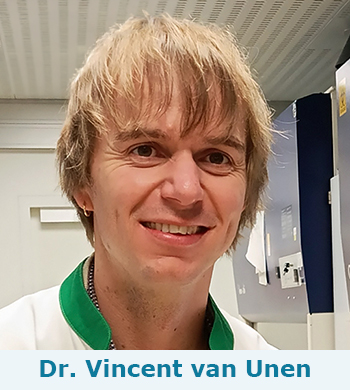 As part of our continuing series of video interviews with
leading IBD researchers, this summer we spoke with Dr. Vincent
van Unen about his team's recent findings from a Propel a
Cure-funded study. Among the exciting discoveries discussed
were how genetic risk factors influence T-cell behavior in
IBD, why the underlying mechanisms of Crohn's disease and
ulcerative colitis may be more similar than previously
thought, and intriguing clues pointing to specific viruses and
fungi that may be just the "tip of the iceberg" in identifying
the triggers of IBD.
As part of our continuing series of video interviews with
leading IBD researchers, this summer we spoke with Dr. Vincent
van Unen about his team's recent findings from a Propel a
Cure-funded study. Among the exciting discoveries discussed
were how genetic risk factors influence T-cell behavior in
IBD, why the underlying mechanisms of Crohn's disease and
ulcerative colitis may be more similar than previously
thought, and intriguing clues pointing to specific viruses and
fungi that may be just the "tip of the iceberg" in identifying
the triggers of IBD.
Dr. van Unen is an Assistant Professor of Immunology at the
Leiden University Medical Center in the Netherlands, where he
leads the Vincent van Unen Research Group. He is an expert in
mucosal immunology, with a focus on immune-mediated
inflammatory disorders. His lab aims to dissect key immune
mechanisms driving disease, with the goal of improving
diagnostic precision and developing more effective treatments
for chronic intestinal conditions.
Click
here
to watch the video.
|
RESEARCH REVIEW
A CURATED ROUNDUP OF RECENT
IBD RESEARCH AND NEWS
|
"Researchers at the Icahn School of Medicine at Mount Sinai
have found that exposure to per- and polyfluoroalkyl
substances (PFAS), commonly known as ‘forever chemicals,'
during pregnancy and early life is associated with increased
intestinal inflammation during childhood." PFAS can be found
in nonstick cookware, food packaging, stain-resistant fabrics,
and firefighting foam.
Article Link:
Mount Sinai Newsroom
|
Scientists have discovered a hidden molecular defect that may
help explain why flare-ups can return even when IBD patients
feel well.
Article Link:
SciTech Daily
|
Scientists from Weill Cornell Medicine have found that treating intestinal Candida overgrowth with the systemic antifungal fluconazole was associated with changes in the gut microbiome and improvements in disease activity in some patients with mild-to-moderate IBD.
The study was small and was not randomized or
placebo-controlled, so it cannot establish that fluconazole
treats IBD. The researchers are now planning a larger clinical
trial to determine whether these findings can be confirmed and
which patients might benefit.
Article Link:
Cornell Chronicle
|
Researchers at McMaster University have developed a
bacteriophage (phage) therapy that targets specific bacteria
linked to inflammation in some people with Crohn's disease,
without disrupting the broader gut microbiome. In preclinical
models, the therapy has reduced inflammation. The findings
support further research into more targeted, personalized
treatments for IBD.
Article Link:
Medical Xpress
|

HOPE BUILDERS
GROWING HOPE. ADVANCING RESEARCH.
|
Hope Builders are the community behind Propel a Cure's
year-round investment in promising Crohn's research.
|
With Gratitude to Our Hope Builders
|
Raihaneh
Bokharai
|
Kimberly
Brown
|
|
Imran
Chaudry
|
Sue
Cragg
|
|
Vince
Cvijanovic
|
Dina
Fiatarone
|
|
Manuela
Gonzalez-Bueno
|
Stephen
Hall
|
|
Tracy
Loewenthal
|
Diana
Miguens
|
|
Natalie
Muccioli
|
Federico
Nan
|
|
Gustavo
Nonohay
|
Kathleen
Pinckney
|
|
Anthea
Pritchard
|
Devin
Rasmussen
|
|
Hellie
Saffery
|
Lakshmi
Sampath
|
|
Misty
Triplett
|
Angela
Vilomar
|
|
Elizabeth
Voisard
|
Eric
Voisard
|
|
An Inside Look at What's Next
Exclusive Hope Builder Webinar Coming in November!
|
Hope Builders will be invited to hear from the Stanford team
leading Propel a Cure's newly funded research into
mitochondrial dysfunction in Crohn's disease and ask questions
about their work, including laboratory testing of a potential
new treatment.
To receive an invitation to this exciting event, become a Hope Builder by making a monthly, quarterly, or yearly
gift of any amount. Small recurring gifts can add up to major impact!
|
|
Employer Matching Opportunities
|
|
Want to double your donation to help cure Crohn's disease? Some companies will match donations made by their employees to nonprofits like Propel a Cure. Does yours? It's worth asking!
|
Thank you for your support!
|
Thank you for supporting
Propel a Cure! If you can get involved,
please let us know. We would love to have you
as a volunteer!
If you'd like more information about Propel a Cure or
have suggestions
for topics you'd like to see covered in the next
newsletter, please contact
us at
info@propelacure.org.
Together we can make a difference!
|

ANGELA CLARK
President and CEO
|
|

info@propelacure.org
|
PropelaCure.org

|


